In search of the best AI virtual assistant? An AI virtual assistant is software that uses machine learning to help you get more done — it turns a rough idea into a polished result in seconds. When choosing one, weigh output quality, pricing, export formats, and how well it fits the tools you already use. Whether you are a beginner or a pro, the right AI virtual assistant slots into your workflow and pays for itself fast. Below we compare features, pricing, and real output so you can choose with confidence.
Catalog server
A catalog server provides a single point of access that allows users to centrally search for information across a distributed network. In other words, it indexes databases, files and information across large network and allows keywords, Boolean and other searches. If you need to provide a comprehensive searching service for your intranet, extranet or even the Internet, a catalog server is a standard solution.
Z.ai
Knowledge Atlas Technology Joint Stock Co., Ltd., branded internationally as Z.ai, is a Chinese technology company specializing in artificial intelligence (AI). The company was formerly known as Zhipu AI outside China until its rebranding in 2025. Z.ai's flagship product is the GLM (General Language Model) family of large language models, which the company has released under the free and open-source MIT License since July 2025. As of 2024, it is one of China's "AI tiger" companies by investors and considered to be the third-largest LLM market player in China's AI industry according to the International Data Corporation. In January 2025, the United States Commerce Department blacklisted the company in its Entity List due to national security concerns. == History == Founded in 2019, the startup company began from Tsinghua University and was later spun out as an independent company. Researchers published an Association for Computational Linguistics conference paper in May 2022 introducing the GLM (General Language Model) training algorithm, which uses an "autoregressive blank infilling" strategy that creates cloze tests by randomly removing segments of input text and trains the model to autoregressively regenerate the removed text. In 2023, it raised 2.5 billion yuan (approx. 350 million in USD) from Alibaba Group and Tencent, along with Meituan, Ant Group, Xiaomi, and HongShan. In March 2024, Zhipu AI announced it was developing a Sora-like technology to achieve artificial general intelligence (AGI). In May 2024, the Saudi Arabian finance firm Prosperity7 Ventures, LLC participated in a USD $400 million financing round for Zhipu AI with a valuation of approximately 3 billion USD. In July 2024, they debuted the Ying text-to-video model. Zhipu released GLM-4-Plus in August 2024. In October 2024, Zhipu released GLM-4-Voice, an end-to-end speech large language model that can adjust its tone or dialect. Zhipu disclosed in April 2025 that it had started preparing for its initial public offering (IPO) and released two models under the free and open-source MIT License. In May 2025, the company sealed a 61.28 million yuan deal from the Chinese government for city projects in Hangzhou. In July 2025, Zhipu AI released GLM-4.5 and GLM-4.5 Air, their next generation language models, and the company rebranded itself as Z.ai internationally. In August 2025, Z.ai announced that their GLM models are compatible with Huawei's Ascend processors. On August 11, 2025, Z.ai released a new vision-language model (VLM) with a total of 106B parameters, GLM-4.5V. In late September 2025, the company released GLM-4.6 using China's domestic chips such as those from Cambricon Technologies. Z.ai released GLM-4.6V and GLM-4.7 in December 2025. That same year, the company changed its official name to Knowledge Atlas Technology JSC Ltd. On 8 January 2026, Z.ai held its IPO on the Hong Kong Stock Exchange to become a listed company. It is considered to be China's first major LLM company that went through an IPO. On February 11, 2026, Z.ai released GLM-5. In late February 2026, Z.ai's shares fell by 23%, and had a shortage of compute resources, leading to user complaints and Z.ai issuing a public call for support. Z.ai also restricted new user signups. In late March, 2026, Z.ai released the GLM-5.1 model to subscription users. On April 8th, 2026, Z.ai released GLM-5.1 as open-source. The same day, Z.ai increased its API prices by 10%, but maintained a lower price than its United States competitor Anthropic's Opus 4.6 model. On release, the company's share price increased 11.5%. == Description == Z.ai provides the following products and services: General Language Model (commonly abbreviated as GLM; formerly known as ChatGLM), a series of pre-trained dialogue models initially developed by Zhipu AI and Tsinghua KEG in 2023. GLM 4.5, released in July 2025 by Z.ai, can run on eight NVIDIA H20 chips. The release of GLM-4.6 in late September 2025 marked the first integration of FP8 and Int4 quantization on Cambricon chips. It also supports native FP8 on Moore Threads GPUs. Ying, a text-to-video model that generates image and text prompts into a six-second video clip for around 30 seconds. AutoGLM, an AI agent application that uses voice commands to complete tasks within a smartphone. The app can analyze complex tasks such as ordering an item from a nearby store and repeating an order based from the user's shopping history. AMiner, created by Jie Tang (co-founder of Z.ai) in March 2006, now owned by Z.ai. Z.ai has offices in the Middle East, United Kingdom, Singapore, and Malaysia, along with innovation center projects across Southeast Asia (2025). In January 2025, the United States Commerce Department added the company to its Entity List, citing national security concerns. == Models ==
AI-assisted virtualization software
AI-assisted virtualization software is a type of technology that combines the principles of virtualization with advanced artificial intelligence (AI) algorithms. This software is designed to improve efficiency and management of virtual environments and resources. This technology has been used in cloud computing and for various industries. == History == Virtualization originated in mainframe computers in the 1960s in order to divide system resources between different applications. The term has since broadened. The use of AI in virtualization significantly increased in the early 2020s. == Uses == AI-assisted virtualization software uses AI-related technology such as machine learning, deep learning, and neural networks to attempt to make more accurate predictions and decisions regarding the management of virtual environments. Features include intelligent automation, predictive analytics, and dynamic resource allocation. Intelligent Automation: Automating tasks such as resource provisioning and routine maintenance. The AI learns from ongoing operations and can predict and perform necessary tasks autonomously. Predictive Analytics: Utilizing AI to analyze data patterns and trends, predicting future issues or resource requirements. It aids in proactive management and mitigation of potential problems. Dynamic Resource Allocation: Through the analysis of real-time and historical data, the AI system dynamically assigns resources based on demand and need, optimizing overall system performance and reducing wastage. AI-assisted virtualization software has been used in cloud computing to optimize the use of resources and reduce costs. In healthcare, these technologies have been used to create virtual patient profiles. They are also used in data centers to improve performance and energy efficiency. It has also been used in network function virtualization (NFV) to improve virtual network infrastructure. Implementing this type of software requires a high degree of technological sophistication and can incur significant costs. There are also concerns about the risks associated with AI, such as algorithmic bias and security vulnerabilities. Additionally, there are issues related to governance, the ethics of artificial intelligence, and regulations of AI technologies.
Library classification
A library classification is a system used within a library to organize materials, including books, sound and video recordings, electronic materials, etc., both on shelves and in catalogs and indexes. Each item is typically assigned a call number, which identifies the location of the item within the system. Materials can be arranged by many different factors, typically in either a hierarchical tree structure based on the subject or using a faceted classification system, which allows the assignment of multiple classifications to an object, enabling the classifications to be ordered in many ways. == Description == Library classification is an important and crucial aspect in library and information science. It is distinct from scientific classification in that it has as its goal to provide a useful ordering of documents rather than a theoretical organization of knowledge. Although it has the practical purpose of creating a physical ordering of documents, it does generally attempt to adhere to accepted scientific knowledge. Library classification helps to accommodate all the newly published literature in an already created order of arrangement in a filial sequence. Library classification can be defined as the arrangement of books on shelves, or description of them, in the manner which is most useful to those who read with the ultimate aim of grouping similar things together. Library classification is meant to achieve these four purposes: ordering the fields of knowledge in a systematic way, bring related items together in the most helpful sequence, provide orderly access on the shelf, and provide a location for an item on the shelf. Library classification is distinct from the application of subject headings in that classification organizes knowledge into a systematic order, while subject headings provide access to intellectual materials through vocabulary terms that may or may not be organized as a knowledge system. The characteristics that a bibliographic classification demands for the sake of reaching these purposes are: a useful sequence of subjects at all levels, a concise memorable notation, and a host of techniques and devices of number synthesis. == History == Library classifications were preceded by classifications used by bibliographers such as Conrad Gessner. The earliest library classification schemes organized books in broad subject categories. The earliest known library classification scheme is the Pinakes by Callimachus, a scholar at the Library of Alexandria during the third century BC. During the Renaissance and Reformation era, "Libraries were organized according to the whims or knowledge of individuals in charge." This changed the format in which various materials were classified. Some collections were classified by language and others by how they were printed. After the printing revolution in the sixteenth century, the increase in available printed materials made such broad classification unworkable, and more granular classifications for library materials had to be developed in the nineteenth century. In 1627 Gabriel Naudé published a book called Advice on Establishing a Library. At the time, he was working in the private library of Président à mortier Henri de Mesmes II. Mesmes had around 8,000 printed books and many more Greek, Latin and French written manuscripts. Although it was a private library, scholars with references could access it. The purpose of Advice on Establishing a Library was to identify rules for private book collectors to organize their collections in a more orderly way to increase the collection's usefulness and beauty. Naudé developed a classification system based on seven different classes: theology, medicine, jurisprudence, history, philosophy, mathematics, and the humanities. These seven classes would later be increased to twelve. Advice on Establishing a Library was about a private library, but within the same book, Naudé encouraged the idea of public libraries open to all people regardless of their ability to pay for access to the collection. One of the most famous libraries that Naudé helped improve was the Bibliothèque Mazarine in Paris. Naudé spent ten years there as a librarian. Because of Naudé's strong belief in free access to libraries to all people, the Bibliothèque Mazarine became the first public library in France around 1644. Although libraries created order within their collections from as early as the fifth century BC, the Paris Bookseller's classification, developed in 1842 by Jacques Charles Brunet, is generally seen as the first of the modern book classifications. Brunet provided five major classes: theology, jurisprudence, sciences and arts, belles-lettres, and history. Classification can now be seen as a provider of subject access to information in a networked environment. == Types == There are many standard systems of library classification in use, and many more have been proposed over the years. However, in general, classification systems can be divided into three types depending on how they are used: === Universal schemes === Covers all subjects, e.g. the Dewey Decimal Classification (DDC), Universal Decimal Classification (UDC), and Colon Classification (CC). === Specific classification schemes === Covers particular subjects or types of materials, e.g. Iconclass (art), British Catalogue of Music Classification, and Dickinson classification (music), or the NLM Classification (medicine). === National schemes === Specially created for certain countries, e.g. Swedish library classification system, SAB (Sveriges Allmänna Biblioteksförening). The Library of Congress Classification was designed around the collection of the US Library of Congress and has an American, European, and Christian bias. Nevertheless, it is used widely in large academic and research libraries. In terms of functionality, classification systems are often described as: === Enumerative === Subject headings are listed alphabetically, with numbers assigned to each heading in alphabetical order. === Hierarchical === Subjects are divided hierarchically, from most general to most specific. === Faceted/analytico-synthetic === Subjects are divided into mutually exclusive orthogonal facets. There are few completely enumerative systems or faceted systems; most systems are a blend but favouring one type or the other. The most common classification systems, LCC and DDC, are essentially enumerative, though with some hierarchical and faceted elements (more so for DDC), especially at the broadest and most general level. The first true faceted system was the colon classification of S. R. Ranganathan. == Methods or systems == Classification types denote the classification or categorization according to the form or characteristics or qualities of a classification scheme or schemes. Method and system has similar meaning. Method or methods or system means the classification schemes like Dewey Decimal Classification or Universal Decimal Classification. The types of classification is for identifying and understanding or education or research purposes while classification method means those classification schemes like DDC, UDC. === English language universal classification systems === The most common systems in English-speaking countries are: Dewey Decimal Classification (DDC) Library of Congress Classification (LCC) Universal Decimal Classification (UDC) Other systems include: Book Industry Standards and Communications (BISAC), originally developed for use by U.S. booksellers, has become increasingly popular in libraries. Bliss bibliographic classification used in some British libraries Colon classification (CC) Garside classification used in most libraries of University College London Gladstone Library Classification, devised by W.E. Gladstone and used exclusively at Gladstone's Library Harvard-Yenching Classification, an English classification system for Chinese language materials === Non-English universal classification systems === German Regensburger Verbundklassifikation (RVK) A system of book classification for Chinese libraries (Liu's Classification) library classification for user New Classification Scheme for Chinese Libraries Nippon Decimal Classification (NDC) Chinese Library Classification (CLC) Korean Decimal Classification (KDC) Russian Library-Bibliographical Classification (BBK) Swedish library classification system (SAB) === Universal classification systems that rely on synthesis (faceted systems) === Bliss bibliographic classification Colon classification Cutter Expansive Classification Universal Decimal Classification Newer classification systems tend to use the principle of synthesis (combining codes from different lists to represent the different attributes of a work) heavily, which is comparatively lacking in LC or DDC. == Practice == Library classification is associated with library (descriptive) cataloging under the rubric of cataloging and classification, sometimes grouped together as technical serv
Ameca (robot)
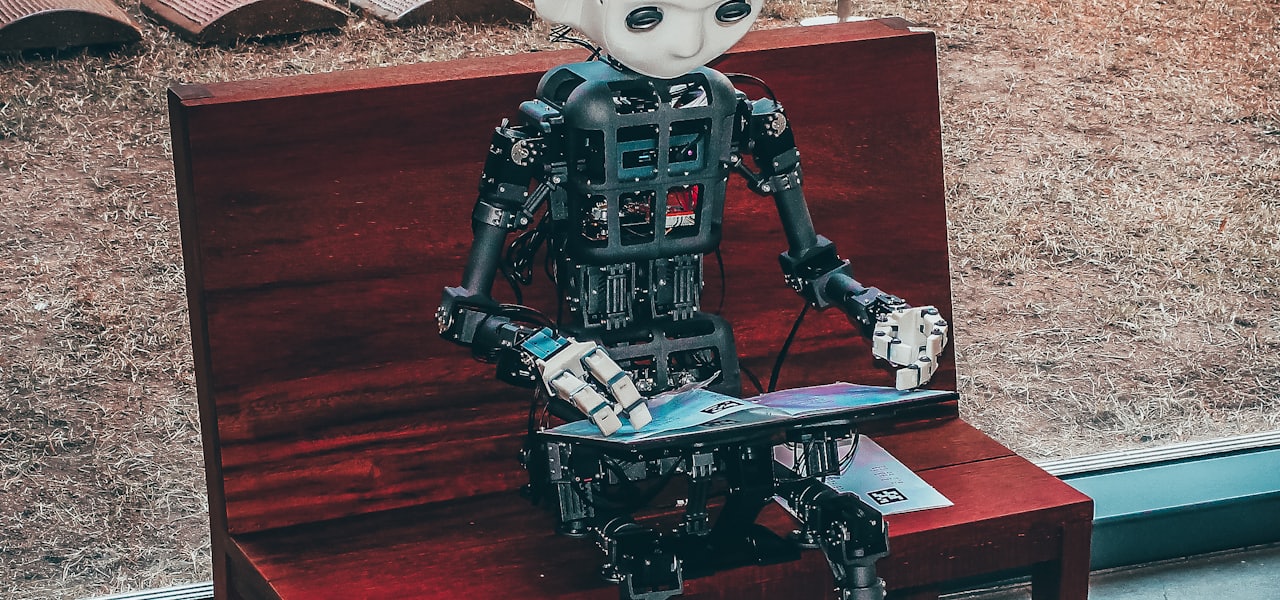
Ameca is a robotic humanoid created in 2021 by Engineered Arts, headquarters in Falmouth, Cornwall, United Kingdom. The project commenced in February 2021, and the first public demonstration was at the CES 2022 show in Las Vegas. Ameca's appearance features grey rubber skin on the face and hands, and is specifically designed to appear genderless. In 2024, an Ameca unit was installed in Edinburgh in the UK to reside at the National Robotarium. Ameca generation 3 has been released and showcased at ICRA 2025 along with Ami. == History == The first generation of Ameca was developed at Engineered Arts headquarters in Falmouth, Cornwall, United Kingdom. The project started in February 2021, with the first video revealed publicly on 1 December 2021. Ameca gained widespread attention on Twitter and TikTok ahead of its first public demonstration at the Consumer Electronics Show 2022, where it was covered by CNET and other news outlets. In 2022, Ameca presented an Alternative Christmas message by British TV Channel 4 for Christmas Day. Ameca was associated with the Museum of the Future's robotic family, where it could interact with visitors. In 2024, an Ameca unit was installed in Edinburgh in the UK to reside at the National Robotarium. In January 2026, Ameca served as an ambassador for the European Space Agency (ESA) at the 18th European Space Conference. == Features == It is designed as a platform for further developing robotics technologies involving human-robot interaction. utilizes embedded microphones, binocular eye mounted cameras, a chest camera and facial recognition software to interact with the public. Interactions can be governed by either OpenAI's GPT-3 or human telepresence. It also features articulated motorized arms, fingers, neck and facial features. Ameca's appearance features grey rubber skin on the face and hands, and is specifically designed to appear genderless. == Public appearances == Computer History Museum, California Heinz Nixdorf MuseumsForum, Paderborn, Germany Copernicus Science Center, Warsaw, Poland Museum of the Future, Dubai Consumer Electronics Show 2022 Deutsches Museum Nuremberg OMR Festival 2022 Hosted by Vodafone GITEX 2022 International Conference on Robotics and Automation 2023 International Telecommunication Union AI for Good Global Summit 2023 Sphere (Not Ameca, Custom humanoid named Aura built on Ameca technology)
No Fakes Act
The NO FAKES Act or the Nurture Originals, Foster Art, and Keep Entertainment Safe Act, is proposed United States federal legislation concerning digital replicas. The bill was first introduced in 2023 as a discussion draft, formally introduced in 2024, and reintroduced in 2025. If enacted, the bill would establish a federal right of publicity, giving public figures and private individuals greater control over the creation and use of digital replicas of their likenesses, including artificial intelligence (AI)-generated content. If passed, the NO FAKES Act would create a legal framework for licensing digital replicas, including provisions for liability, safe harbors, and statutory exceptions. The proposal has received broad support from the entertainment and technology industries. However, digital rights organizations have raised concerns that the Act risks chilling protected speech. == Background == === Entertainment industry concerns === Actors’ concerns over studios' use of their digital likeness were one of the primary drivers of the Screen Actors Guild–American Federation of Television and Radio Artists (SAG-AFTRA) strike in 2023. Negotiators for SAG-AFTRA alleged that the Alliance of Motion Picture and Television Producers (AMPTP) sought to use the digital likenesses of actors in perpetuity and would try to replace union members, especially background actors. The AMPTP denied SAG-AFTRA's interpretation of its proposal. In November 2023, AMPTP and SAG-AFTRA reached an agreement on the use of actors’ digital replicas, which included requirements for consent and compensation. Recording labels have also expressed concerns over unauthorized digital replicas of their performers' likeness. In 2023, TikTok user Ghostwriter977 released "Heart on My Sleeve," an AI-produced song in the styles of Drake and the Weeknd. After the song received millions of streams, the Universal Music Group (UMG) initiated takedown requests to TikTok and YouTube, which removed the song from their platforms. The legal arguments attorneys made were not disclosed; however, commentators noted that they likely used the Digital Millennium Copyright Act (DMCA). This presented a novel scenario, since UMG did not have licensing rights to "Heart on My Sleeve." According to The Verge, UMG based its DMCA takedown request on an unauthorized sample used at the start of the song for the producer tag. While legal commentators noted that UMG could have asserted a violation of the artists’ rights of publicity, existing state right of publicity laws do not provide notice-and-takedown mechanisms comparable to those under the DMCA. === Legal landscape === Legal scholars have observed that AI-generated digital replicas raise questions under existing copyright and intellectual property law. U.S. copyright law generally requires that original authorship be attributable to a human; however, the extent of human intervention needed to satisfy this requirement is not clear. Copyright holders have filed lawsuits against AI companies alleging unauthorized usage of copyrighted material to train their models, though many of these cases remain pending. In terms of outputs, record labels often hold rights to artists’ musical works but do not necessarily control the artists’ voice, appearance, or likeness in the same way. As a result, AI-generated recordings such as "Heart on My Sleeve" may fall outside the scope of certain traditional copyright protections. Individuals' likenesses have historically been governed under the Lanham Act, the Federal Trade Commission Act, and right of publicity laws. The right of publicity, recognized in many state-level statutes and common law, allows individuals to bring legal claims against unauthorized commercial use of their identities. It has often, but not exclusively, been applied to celebrities or other recognizable individuals. There is no federal-level right to publicity, and state-level protections vary, especially on issues relating to digital replicas and posthumous rights, which makes it difficult for creators or other individuals to prevent unauthorized use of their likenesses. In July 2024, the U.S. Copyright Office released a report on digital replicas and recommended that Congress create a federal law to protect individuals from unauthorized uses of their digital replicas, noting the inadequacy, narrowness, and inconsistency of existing laws. == Provisions == Under the NO FAKES Act of 2025, a digital replica is defined as "a newly created, computer-generated, highly realistic electronic representation that is readily identifiable as the voice or visual likeness of an individual," living or dead. A digital replica can be embodied in sound recordings, images, or audiovisual works in which the individual did not perform or in which the individual did perform but the "fundamental character of the performance or appearance has been materially altered." The Act specifies that digital replicas do not include reproduced samples of works authorized by the copyright holder. The Act defines a "right holder" as either the individual who is the subject of a digital replica or an entity that has acquired the rights to that individual’s likeness. The Act grants right holders the exclusive right to authorize the use of an individual’s likeness in a digital replica. This right is not assignable during the individual’s lifetime; however, it can be licensed to a living individual for up to 10 years under certain conditions. Postmortem rights The Act provides that the right does not automatically expire upon an individual’s death. It may be transferred to executors, heirs, or other parties designated by the individual. The right is held by the right holder for 10 years following the individual’s death. If the right holder demonstrates active use of the digital replica within the 2 years preceding the end of the 10-year term, the right may be extended for an additional 5-year period. These five-year extensions may be renewed for up to 70 years after the individual’s death. Liability The Act establishes liability for individuals who knowingly distribute a digital replica without authorization from the right holder, as well as for entities that make available a service primarily designed to produce unlawful digital replicas. Safe harbor provisions Similar to the Communications Decency Act and the DMCA, the Act establishes safe harbor provisions for online service providers. Providers are shielded from liability if they adopt and inform users of a policy for terminating accounts that repeatedly violate the Act. The NO FAKES Act does not require online services to proactively monitor content. Instead, it creates a notice-and-takedown mechanism under which providers must promptly respond to notifications seeking the removal of unauthorized digital replicas. These safe harbor protections apply only if the online service provider designates an agent with the U.S. Copyright Office to receive notifications of alleged violations. Remedies The NO FAKES Act provides remedies that are similar to those available under U.S. copyright law. Under the Act, individuals may be held liable for either statutory damages of $5,000 or actual damages for creating or distributing an unauthorized digital replica. The legislation also establishes a tiered liability framework for online service providers. Those that make good faith efforts to comply with the Act may face statutory damages of up to $25,000 per work for violations or actual damages. Providers that do not undertake such compliance efforts may be liable for $5,000 per unauthorized display or transmission of a digital replica, with damages capped at $750,000 per work. Exclusions The Act includes several exceptions to liability that are modeled in part on fair use principles. Digital replicas are excluded from liability when "used in a bona fide news, public affairs, or sports broadcast or account;" in a documentary or historical context; or in a way that is "consistent with the public interest." These exclusions do not apply to de minimis uses or to digital replicas that are sexually explicit in nature. The Act further states that licensing requirements do not apply to licenses established through collective bargaining agreements that contain provisions governing the use of digital replicas. The Act does not impose secondary liability on providers of generative artificial intelligence tools or services whose primary purpose is not the creation of unauthorized digital replicas. Preemption The NO FAKES Act preempts laws that protect "an individual's voice and visual likeness rights in connection with a digital replica, as defined in this Act, in an expressive work." However, the Act preserves state laws governing digital replicas enacted before January 2, 2025, as well as state laws addressing digital replicas that portray sexually explicit conduct. == History == In 2023, Senators Marsha Blackburn, Chris Coons, Amy Klobuchar, and Th